
Klaviyo is best-in-class at telling you who your best customers are. Between its order data, its predictive analytics and its Klaviyo RFM grouping, it can separate the people who buy often and spend a lot from the people who bought once on a sale. That makes Klaviyo the right place to decide who has earned something more personal than another email.
This guide turns that data into three mail-worthy tiers: current VIPs, future VIPs, and VIPs who are starting to slip. For each tier you get the Klaviyo conditions, the extra conditions that make the segment mailable, and whether to send it as a one-time campaign or an automated flow in Tangible Post. It assumes you already know the mechanics of sending direct mail from a Klaviyo segment. This is about building the segment itself.
RFM in plain terms
RFM stands for recency, frequency and monetary value: how recently someone ordered, how often they order, and how much they've spent. It's an old retail idea, and it maps neatly onto the VIP question. A VIP is someone who scores high on frequency and monetary value. An at-risk VIP is someone who still scores high on those two, but whose recency is slipping.
You'll also see CLV, short for customer lifetime value. Klaviyo shows two versions on a profile:
- Historic CLV: the total value of someone's past orders, net of refunds and cancellations.
- Predicted CLV: what Klaviyo expects that customer to spend over your prediction period, which is one year by default.
There are two ways to get RFM tiers out of Klaviyo:
- Klaviyo's RFM report. If your account includes it (it's part of Klaviyo's Advanced KDP, a paid add-on), Klaviyo scores every customer on recency, frequency and monetary value and places them in groups such as Champions, Loyal, Needs attention and At risk. You can build a segment with
Properties about someone>Current RFM group>equals> the group you want. - Build the tiers from conditions. Without the report, you can build the same tiers yourself:
Placed Ordercount is frequency, how recentlyPlaced Orderhappened is recency, and Historic CLV is monetary value.
The recipes below use the second method, so they work in more accounts. Where an RFM group is a good shortcut, it's noted.
Check that predictive analytics are on
Several conditions below use Klaviyo's predictive analytics. Klaviyo only shows CLV predictions when the account has:
- At least 500 customers who have placed an order (people with real orders, not total profiles)
- An ecommerce integration or the Klaviyo API sending placed orders
- At least 180 days of order history, with orders in the last 30 days
- Some customers who have placed 3 or more orders
Klaviyo's RFM report has the same requirements. A profile that doesn't qualify won't match CLV conditions, so if a big share of your customers don't qualify yet, use the order-count fallbacks in Tiers 1 and 3. Tier 2 relies on Klaviyo's predictions, so hold it until your account qualifies. And set your CLV thresholds from your own customers. There's no universal VIP number, and copying someone else's cutoff will put the wrong people in the segment.
Why VIPs get the handwritten package
Your best customers already get your emails and see your ads. Mail that looks like everyone else's mass mail doesn't set them apart, which is why a generic promo postcard tends to undersell this group. We covered that choice in when a Klaviyo segment needs a handwritten package.
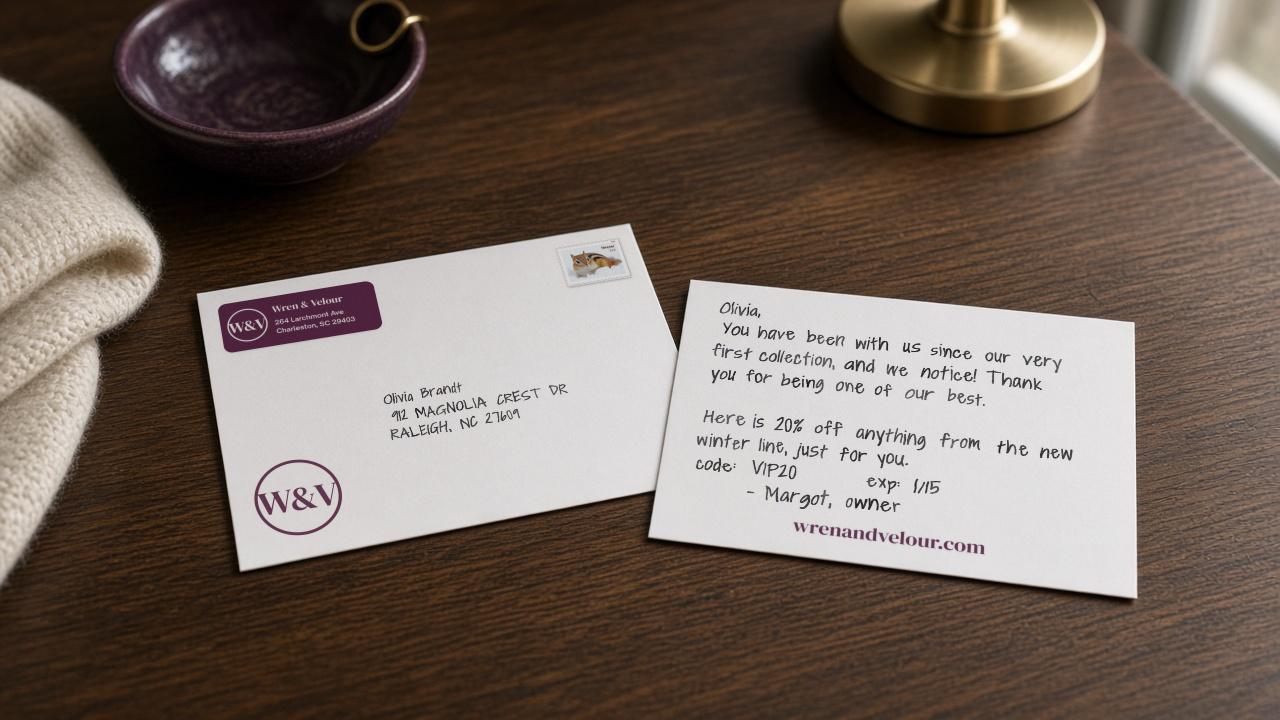
What Tangible Post sends is one consistent branded package: a handwritten note on your custom-printed card, a handwritten address, a real stamp, and an optional custom-printed envelope and return label. For a VIP tier, that's the right default. It's personal, it clearly comes from your brand, and the group is small enough that each piece can be worth it.
The mail-ready layer: add it to every tier
A Klaviyo segment can be full of your most engaged customers and still not be mailable. Add these conditions to every tier, joined with AND:
Properties about someone>Country>equals>United States. Tangible Post mails to US addresses.Properties about someone>City>is setProperties about someone>State / Region>is setProperties about someone>Zip Code>is set- If
Addressappears in the properties list in your account, addAddress>is setas well. What someone has done (or not done)>Mailpiece Mailed>Zero times>In the last>90 days
That last line works because Tangible Post writes mail events back onto each Klaviyo profile: Mailpiece Created, Mailpiece Mailed, Offer Redeemed and Purchase Attributed To Mail. Ninety days matches Tangible Post's default flow cooldown (more on that below). If you've changed your cooldown, use your own number.
A few things to keep in mind:
- Join exclusions with AND. Negative conditions joined with OR tend to pull in people you meant to leave out.
- Expect a smaller mailable count. Tangible Post only mails contacts whose address checks out as Valid or Corrected. Error contacts aren't mailed and aren't charged, so the mailable number can come in below your Klaviyo headcount.
- Keep Klaviyo addresses current. Re-syncing a Klaviyo audience keeps any address you fixed in Tangible Post, unless that customer's address changes in Klaviyo. It's still worth correcting addresses in Klaviyo too, so your email and mail records match. Building a mailable audience covers how addresses get checked.
- Email consent is your policy call. Klaviyo's
If someone can or cannot receive marketingcondition is about email, SMS and push, not mail, and Tangible Post doesn't require email consent to send a package. If your brand treats an email unsubscribe as "don't contact me at all," addcan receiveemail marketing as a condition.
Tier 1: Current VIPs
These are the people who have already earned VIP treatment and have ordered recently enough that a thank-you still feels current.
Conditions, joined with AND:
- Your VIP test. Either
What someone has done (or not done)>Placed Order>Is at least>4>Over all time(Klaviyo's own starting point for a more exclusive repeat-purchaser segment), orPredictive analytics about someone>Historic Customer Lifetime Value>is at least> your spend threshold. If you want both as alternatives, join those two with OR, then AND the rest. What someone has done (or not done)>Placed Order>At least once>In the last>180 days. They're still buying. Adjust to your repurchase cycle.- The mail-ready layer.
RFM report shortcut: Current RFM group > equals > Champions. Klaviyo describes Champions as customers who bought recently, buy often and spend the most. Add Loyal with OR if you want a wider group.
Campaign or flow:
- Use a one-time campaign for a scheduled recognition piece: a holiday thank-you, an anniversary month, or an early look at a new season. A campaign needs between 100 and 15,000 mailable contacts.
- Use a segment-entry flow for "you just became a VIP," the moment someone first clears your order-count or spend bar. A flow sends each person at most one card, ever, so don't use that same flow for a yearly thank-you. Repeat recognition belongs in campaigns.
If you're under 100 mailable: lower the order count from 4 to 3, widen "in the last 180 days" to 270 or 365, or join this tier with Tier 2 using OR. If it's still a small group of genuinely high-value people, use a flow rather than watering down what VIP means.
Tier 2: Future VIPs
Klaviyo's own example of a useful segment is customers with a high predicted lifetime value who are likely to become VIPs.
Conditions, joined with AND:
Predictive analytics about someone>Predicted Customer Lifetime Value>is at least> your threshold for the prediction periodWhat someone has done (or not done)>Placed Order>At least once>Over all time, so they're customers, not prospects- Optional:
Predictive analytics about someone>Predicted number of orders>is at least>1, or your own number - Optional:
Placed Order>Is at most>3>Over all time, if you want rising customers and not people already in Tier 1. If you use this, don't also require 4 or more orders. - The mail-ready layer.
Campaign or flow: a segment-entry flow is the natural fit, since each new high-potential customer gets one early-loyalty package when Klaviyo's prediction puts them over your line. Use a campaign for a one-time pass over everyone who already qualifies, once that group is at least 100 mailable.
Keep the cutoff strict. If you lower the Predicted CLV bar to reach a much bigger "promising" group, you're no longer mailing VIPs. Keep the handwritten package for the strict cutoff. Tangible Post's printed 6x9 card is coming soon and isn't available to order yet. When it is, a wider group like that may be a better fit for it.
Tier 3: At-risk VIPs
This tier catches high-value customers while they're slipping, not after they're gone. It isn't a general lapsed-customer list.
Conditions, joined with AND:
Predictive analytics about someone>Historic Customer Lifetime Value>is at least> the same spend threshold you used in Tier 1Predictive analytics about someone>Churn Risk Prediction>is at least> a starting threshold such as75. Klaviyo displays churn risk as a percentage, so check how the value appears in your account before you save. Profiles without a churn prediction won't match.What someone has done (or not done)>Placed Order>Zero times>In the last>[Y] daysWhat someone has done (or not done)>Placed Order>At least once>In the last>[Y + Z] days- The mail-ready layer. Also consider excluding anyone with a recent
Purchase Attributed To MailorOffer Redeemed, so you don't mail someone who already responded.
Conditions 3 and 4 keep people in the slipping window and out of a full lapse. For example: zero orders in the last 90 days AND at least one order in the last 180 days. To set Y, look at Average time between purchases for your VIP-like customers and set it near or just past that average. If predictive data is thin, start with a fixed 90 or 120 days and tune it.
No churn prediction yet? Use your Historic CLV or order-count VIP test, AND Placed Order > At least once > Between Y and Y + Z days ago, AND Placed Order > Zero times > In the last Y days.
RFM report shortcut: Klaviyo's Needs attention group is described as valuable customers who haven't purchased recently, which is the closest match to an at-risk VIP. Klaviyo's At risk group is a different thing: customers with a low or medium spending score. For a VIP tier, start with Needs attention.
Build this cut in Klaviyo. Tangible Post can narrow a Klaviyo audience by churn risk (Low, Medium or High) for a one-time campaign, but a segment-entry flow can't use churn as a trigger, so for a flow the at-risk logic lives in your Klaviyo segment.
Campaign or flow: a segment-entry flow is the best default here. When a VIP's risk crosses your line, one card is queued, and with review on by default, you get a chance to look at it first. Use a campaign for a one-time catch-up of the people already in the segment, if that group is at least 100 mailable.
Already gone? If a former VIP hasn't ordered in 180 days or more, they're past this tier. That's a reactivation job, covered in how to win back lapsed ecommerce customers.
Setting up flows without mailing anyone twice
A few Tangible Post flow rules shape how these tiers fit together:
- Segment entry means new entrants. A segment-entry flow queues people who enter the segment after the flow goes live. Whoever is already in the segment at that point is recorded as the starting group and not mailed. To reach them, run a one-time campaign alongside the flow.
- One card per person per flow, ever. This is permanent. Plan repeat recognition as campaigns.
- Cooldown applies across flows. The default cooldown is 90 days (you can set anywhere from 0 to 365), and it covers all of your flows. So a customer who gets a Tier 1 card won't also get a Tier 3 card inside that window.
- Review is on by default, a monthly budget caps flow spend, and a flow needs a return label before it can go live.
- Timing. A handwritten flow gathers the people waiting and creates one order a day, once at least nine people are waiting, or sooner when the first person in line reaches the print urgency window, which is 3 days by default.
- Optional trigger filters are fixed. On a segment-entry flow, Tangible Post can also check Predicted CLV of at least $150, Historic CLV of at least $100, or an expected next order more than 30 days away. These thresholds can't be edited, they only appear when Klaviyo has predictions for your account, and anyone who fails one is skipped and never checked again by that flow. Treat them as extras. Your real VIP thresholds belong in the Klaviyo segment.
What to put in the note
In a one-time campaign, the handwritten message can use {{first_name}}, {{last_name}}, {{company}}, {{city}}, {{coupon_code}} and {{expiration_date}}, plus {{custom:property}} for any Klaviyo field you imported, such as a favorite product. In a flow, you can use the six standard fields but not custom fields, so keep flow messages to those.
For VIPs, the message matters more than the offer. Thank them for being a regular, mention something specific when a campaign gives you the field to do it, and sign it from a real person. Klaviyo's own RFM guidance suggests leaning on smaller discounts, or none, for your best customers, since they don't need one to buy.
If you do include a code, you can use one shared code (10 characters or fewer) or a unique code per recipient, imported from Klaviyo or uploaded. Unique codes make it easier to tie orders back to the mail. Results are counted until one week after the code expires, or for 90 days if there's no expiry.
Quick recap
- Build RFM tiers in Klaviyo with order count (frequency), order recency (recency) and Historic CLV (monetary value), or use Klaviyo's RFM groups if your account has them.
- Current VIPs: recognition campaigns on a schedule, plus a "just became a VIP" flow.
- Future VIPs: a flow for new high-Predicted-CLV customers, with a strict cutoff.
- At-risk VIPs: churn risk plus a slipping window, built in Klaviyo, sent as a flow.
- Add the mail-ready layer to all three, and keep repeat sends in campaigns.
Pick one tier, build it in Klaviyo, and check how many mailable contacts it gives you. That number will tell you whether to start with a campaign or a flow.